
TEEN PREGNANCY INITIATIVE
Rehearse Your Reality
MODULE 1
THE REALITY of BEING A PREGNANT TEEN
Explore the Reality of having a child as a teenager through theatre and decide if its what you really want!
Introduction
The intervention will be aimed at adolescent males and females in Grades 8- 9. It is a psycho-educational initiative designed to encourage young people to develop an understanding of the challenges and difficulties involved in caring for an infant.
TEENAGE PREGNANCY AWARENESS
THEATRE PROGRAMME
Using Augusto Boal’s Community Theatre
By Amanda Gifford for Right to Care
WELCOME AND INTRODUCTION MESSAGE:
Dear __________________(write your name)
Today we are going to be talking about teenage pregnancy prevention and what it might take to avoid becoming pregnant as a teenager so that you can have more time to grow up and take care of yourself before you need to grow up and take care of others.
WHAT WILL YOU LEARN DURING THIS MODULE?
THE PURPOSE OF THE SESSION IS:
(Objectives for the session)
Time: 2 hours ( it can be 1 hour if you want)
- Check-in: Creative and fun warm ups.
- Emptying Circle: Storytelling, listening skills, opening up:
Where are you at/ Self Awareness/ Self Existence/ Self Worth. - Learn about self mastery skills for your own life. How to get to a future that you want.
- Exploring Your Now, your Ideal Future, The Future if you fall pregnant and the choices that you need to make if you don’t want that.
- Short term steps and longer term steps to make that happen.
- Share the learnings, Appreciations and Identifications
- Close and say Goodbye
We are going to use a few games and a bit of theatre and interactive exercises to help us all relax and think together about this situation.
WARM UP GAMES
I would like to start with a name game so that we can all get to know each other and relax a little bit.
PRE-GROUP PREPARATION ( NOTE TO THE COUNSELORS or TEACHERS/ FACILITATORS)
You as councilor, teacher and facilitator must work on yourself and make sure you are open & available to others. Make sure you are prepared for your group and that you have given the group some thought before you get to it. You must focus on your morning groups the night before. Make time, tune in! Be flexible and make adjustments if necessary. This group is a chance for you to share what you are dealing with. You must be prepared to be the example to your clients. If you want them to be open, you must learn to be open.
- BE PRESENT & PREPARED FOR YOUR GROUP & CREATING A LOVING SPACE
2 minutes: Take a moment to welcome everyone to the circle and tell them what you are planning to do for this session. This group is really about getting to know each-other, opening up, and learning to communicate our feelings effectively.
We will also learn to listen.
WARM UP PHASE
- CREATIVE CHECK-IN & ICEBREAKERS
3 minutes: Sound and Movement: Stand in a circle and one person at a time, makes a sound & movement to show how they are feeling today.
The group then copies them. Then the next person goes.
3 minutes: Name and movement: In a circle, one person says their name and does a movement and the group copies. Give each person a turn.
3minutes – Sing a line: The day started with a general warm-up. A person is asked to sing a line of a song that comes to mind and then the rest of the group is asked to sing it back. A few people take turns to sing a line when they can spontaneously think of one.
GAMES help people to relax and open up. It is important to play games with group members. It helps them to get to know each other too. There are many benefits in play.
MEDIUM INTENSITY PHASE
- CIRCLE SITTING
(Credit to Mike Boon and Vulindlela Network, SAWID for this Listening Circle)
Sit down in a circle with the group
(Facilitator)Talk about the AIM of today.
The aim of today is to let people have a chance to speak about what is on their hearts and minds. Where is everyone at in their lives. Anyone can speak but no-one must answer or give advice. Only Listen to eachother. Appreciation can come right at the end.
- Once the Listening Circle is open, whoever feels called to share their story or problem must say his or her name and then speak about what they wrote or discussed.
- When they are finished speaking, she or he must say “I am finished”
- This is not a debate. This is a disciplined ‘listening’ circle. Nobody is allowed to respond to what is said in words while circle is open. Each person must be prepared to listen to that person’s point of view whether they think it is right or wrong.
- If people do not speak, the group must sit in silence to wait for the next speaker in the circle.
Fireside Storytelling “ Emptying” RULES
- Create a circle
- Create a good listening culture
- Tell the group a short bit of what is on your heart and mind
- Share of yourself. Make space for new insight
- Let go of the past by sharing it
- Experience yourself in a new way
- Create hope, trust and love for yourself
- Be aware of other people.
- Don’t take up all the time on your own story
- 1 minutes each.
- WHAT ARE WE TALKING ABOUT
Now that we have spoken about where you are at, now lets look at where you don’t want to be at in the future. We are going to explore the reality of having a child as a teenager through theatre.
HIGH INTENSITY PHASE
REALITY BITES!
EXPLORING THE REALITY & THE FUTURE OF HAVING A CHILD THROUGH THEATRE
TEEN PREGNANCY INITIATIVE
Rehearse Your Reality
MODULE 1
THE REALITY of BEING A PREGNANT TEEN
Explore the Reality of having a child as a teenager through theatre and decide if its what you really want!
Introduction
The intervention will be aimed at adolescent males and females in Grades 8- 9. It is a psycho-educational initiative designed to encourage young people to develop an understanding of the challenges and difficulties involved in caring for an infant.
Facilitator/ Teacher/ Community Counsellor
Outline
A number of work stations will be set up with a class room area or similarly spacious venue. The stations will represent
1. A retail outlet: Checkers, Shoprite, Pick and Pay etc.
2. An employment agency
3. The school
4. SASSA
5. Social Services
6. A crèche
Groups involved
1. Young mothers
2. Young Fathers
3. Caregivers (grandmother, mother, father, uncle etc.)
Other “actors” in the drama
▪ Healthcare workers
▪ Shop keeper
▪ Social worker
▪ Employment agency representative
▪ School Principal
▪ Crèche manager
Introduction
As a preface to the intervention some information may be given regarding the risks of teen pregnancy both for baby and mother.
Each group will comprise a boy-girl pair, plus a caregiver. The boy-girl dyad will be required to follow a series of steps together. The caregiver/parent will be given instructions on his/her role
At the start of the intervention all dyads will be given a batch of cards numbered from 1-10 (or more). The adolescents will be required to begin with card one and follow the steps to completion before they go on to the next card. The cards will direct them to a work station or provide instructions regarding discussions that they need to have with either their partner or caregiver.
In addition each pair will be given a list of items that will be needed for the baby. This list should represent the ideal situation i.e. items that would be required for optimal health and comfort. For example: nappies, bottle, formula, baby clothes and so on. Some input around infant health may be given here
The girls will also be given a doll (the baby) this must be with them all the time; they cannot leave it with anyone.
An example of engagement with other players would be:
Step 1
“You need the following items for your baby. You do not have any money. Discuss the situation with your caregiver parent. Ask them if they will lend you money. Offer to apply for the child support grant (R280.00) and promise you will pay it back.”
In this example the caregiver will be briefed to be accusatory, angry, and resentful. His or her goal will be to make the young person feel as miserable as possible. She will however eventually agree to give R280.00. (Paper money to this value will be given to caregivers for handing over to the adolescent)
Step 2
“You take the list of items you need to the Shoprite workstation and present it to the retailer. How much can you get, what do you have to do without? Do you have any money left? How long are your supplies going to last. What do you plan to do then?”
Step 3
“You realise you need more money. Discuss with the father how he can contribute and how much extra you need”.
(The father is briefed to point out that he is still in school. He has no money. He can’t be involved. He is trying to finish his schooling.) (Given the emphasis on age disparate relationships and transactional sex, should there be older men as partners as well?)
Step 4
“Your baby is unwell. Has a severe nappy rash/is malnourished. You need to take him/her to the clinic workstation.”
In this engagement the adolescent experiences long queues (all the other girls will be there) and a harassed and stigmatizing healthcare worker who berates her about the baby’s health
Step 5
“You decide to apply for the child support grant and discover that you will need to take your caregiver with you. Discuss this with your caregiver/parents and visit the SASA station. Experience long queues and find out that it will take 2 months before you get your grant” (check this)
Step 6
“You need a letter from social services. You visit social services workstation to get this. Also to find out about maintenance.” (I am not sure what the maintenance situation is with under-age adolescents – if the boy’s family would be liable?)
Step 7
“You decide to try and get a job. You visit the employment/recruitment agency, and discover that your qualifications will only allow you to do menial work, but the employers don’t want a baby around”
Step 8
“You feel that your best chance of a future is to return to school and see the school principal. We need to look at recommendations as to return to school after birth of a baby. I recall there is a specified period? If this is the case then this can be presented as a further obstacle. Either way there is the question of who will look after the baby”
Step 9
Discuss with caregiver who will look after the baby. Caregiver briefed to adopt an uncompromising attitude. She “never wanted an extra child in the home, now she must look after it as well!” She insists the baby is put in crèche.
Step 10
“You visit the crèche in your area to ask about costs. Can you afford this amount? How will you cope?
Conclusion
We bring the girls, boys and other players together for discussion and education
General
▪ We would need to decide on the individuals who are placed at each workstations. They could be from an external organisation e.g. community drama or from a higher grade. They would need to be thoroughly briefed on their role.
▪ We could add further work stations but need to be mindful of time. Chances are we will have one hour only
▪ Stigmatisation of teen mothers must be emphasised throughout the process
▪ We need to evaluate (pre-post-test: reduction in teen pregnancy; need to identify a school where rates are high
▪ We need to think about how we can involve stakeholders and get buy in
Requirements:
Dolls
Paper Money
Costing for baby requirements and cards to represent
Colour cards for different steps
Briefing notes for each station/individual
Possible obstacles
1. May have a pregnant child in the class
2. Adolescents involved not taking the lesson seriously
3. Resistance from school principal
4. Evaluation (will take time to report on impact on teen pregnancy rate)
5. Training requirements
6. Counselling support
Write up list of questions to guide the final debate
5. PREPARE FOR STORYTELLING
The instruction is that you
PROCESSING PHASE:
- REFLECTIONS/SHARING RESOURCES
Group Activity: Appreciations and Identifications: Allow the audience to reflect on what they appreciated or identified with in each performance, before the next group performs.
(5 Min)
PRE-CLOSURE PHASE:
9. TAKING IT HOME (Reflections)
(5 min)
REFLECTIONS & CONTAINMENT
Next time I see you, you will be thinking about what you would like your life to be like! What is your dream of the future.
- What are you going to change in your life before we see you again?
- What fears are you going to face?
CLOSURE PHASE
- CHECK-OUT
(10 – 15 min)
- PLAN AHEAD
(5 min) – Set up logistics for the next session. Make sure the group knows the date, time and homework.
- CLOSE
(5 min) – Drama Therapy closure activity:
Let all the participants stand in a circle. Everybody gets the opportunity to sing a song together to close.
Evaluation
Your Name:
Date:
Facilitators Name: Amanda Gifford
Circle the correct one.
- Did I learn to listen better today? YES/ NO
- Did I feel more empowered to run a listening circle in my own clinic? YES/ NO
- Did I feel more aware of my own need to take care of myself and not just others? YES/NO
- Did I feel more connected to the other people in the group? YES/NO
- Did I learn to communicate non-violently? YES/NO
- Did I feel lighter at the end? YES/ NO
- Was I able to appreciate myself and others? YES/ NO
- Did I feel relief after talking about my problems? YES/ NO
- Do you think the storytelling listening circle is valuable? YES/ NO
- How many stars does todays session deserve?
(1 Star = Not good; 5 Stars = Excellent/ extremely good)
☹ 1 Star 2 3 4 5 Star ☺
- Identify 3 things from today that you learnt.
a. ___________________________________________
b. __________________________________________
c. ___________________________________________
- General Comments
__________________________________________
__________________________________________
__________________________________________
___________________________________________________________
- Rate the facilitator
|
Excellent |
|
Good |
|
Average |
|
Poor |
|
Any additional comments |
PLEASE LISTEN
When I ask you to listen to me
And you start giving me advice
You have not done what I have asked
When I ask you to listen to me
And you begin to tell me why
I should feel that way
You are trampling on my feelings
When I ask you to listen to me
And you feel you have to do something
To solve my problem
You have failed me
Strange as it may seem
Listen, All I ask is that you listen
Don’t talk or do
Just Hear me.
Poem written by inmate: participant in Ekhuseni ManAlive group 2005
What message is the poem bringing to you today? (Short discussion) 2 min
TEENAGE PREGNANCY PREVENTION THEATRE TRAINING PROGRAMME PART 2
MODULE 2:
WHAT FUTURE DO YOU WANT?
PROBLEM SOLVING FOR TEENS USING IMAGE THEATRE and DREAM BOARDS
“Life is not about finding yourself, its about creating yourself” George Bernard Shaw
WELCOME AND INTRODUCTION MESSAGE:
It is important that we take 100% responsibility for our future.
VISION & CREATING A NEW FABULOUS FUTURE YOU
If you want to finish school and go to university What are you going to do to get there? Imagine a new future for yourself and begin to plan for it.
CULTIVATE A VISION OF A NEW FUTURE
WHERE AM I AT NOW?
DRAW A PICTURE OF YOURSELF AT THE MOMENT And Your LIFE
Write a few words to describe your life.
NOW
Then draw, the IMAGE OF THE IDEAL FUTURE. What would you like your future to look like?
IDEAL FUTURE
TRANSITION: Then ask yourself how am I going to get to where I want to be?
TRANSITION
Draw and write a few words for that.
Here is an example:
IMAGE THEATRE EXERCISE:
Make a very short piece of movement showing where you are at and then moving to where you want to be, using your body and acting. Make statues of your body of the now, then the transition, then the future. Explore what you need to do to get to the future you desire. Discuss.
Write down the qualities of this future. Educated, Rich, Happy, Married, Loved.
I.E: Happiness, Health, Wealth, Genius, Self Worth, Love and Acceptance
Then make a list of affirmations out of those qualities, as if you already are that.
Ie: I am educated.
I am rich.
I am happy.
I am married.
I am loved.
I love and accept myself unconditionally
AFFIRMATIONS LIST
Rehearse this as if its a script for an actor except this is now your new life. This is your new script.
Discuss your TRANSITION:
How are you going to get to where you want to be in your ideal future?
Does it include children?
Discussion around what fears you need to face to change your future.
If you would like to wait before you have your kids here are some steps for you to take to prevent pregnancy:
1.
Don’t give in to peer pressure. Many teenagers can feel left out/behind when their friends start to have boyfriends, or start having sex. Those who have started to do these things early can often talk about it enough to make others feel left out. However, if you do stand your ground and wait until you know you are ready, you will be glad of it. It means you’ll have waited for the right person and the right time.
▪ Everyone develops at different rates, both physically and mentally, so don’t feel that you should be racing your peers for things like having sex and getting boyfriends.
▪ Many of your peers will regret their choices in time. Others could even be lying. Don’t just start having sex because other people are if you aren’t ready to do it yourself.
▪ Learn to say “No”. This includes saying no to anything you feel uncomfortable with. Whether it’s refusing to have a boyfriend, have any kind of physical contact, have sex or have sex without protection, there is nothing wrong with standing up for yourself. The only 100% safe way to avoid pregnancy is to not have sex, so you shouldn’t feel stupid for not wanting to go through with something.
▪ Know what will and won’t result in pregnancy. With sex in general, there are a lot of myths about what will get you pregnant and what will keep you from getting pregnant. A lot of these myths are simple misinformation, and some of them are lies designed to deceive you. Arm yourself with the facts and lower your chances of pregnancy the safe, smart way.
▪ Unprotected vaginal sex has the highest likelihood of resulting in pregnancy. Male sperm fertilizes the female egg, resulting in the growth of a fetus. Unprotected sex also carries a high risk of disease and infection.
▪ Pulling out carries some risk of pregnancy. Studies show that typical use of withdrawal has a 18% chance of resulting in pregnancy.[1] This is because some sperm may be released in the male’s pre-seminal fluid, or simply because the male doesn’t pull out quickly enough.
▪ Unprotected anal sex by itself cannot result in unwanted pregnancy.[2] But because the anus and the vagina are extremely close to each other, there is a chance that sperm could accidentally leak into the vagina, causing pregnancy. Unprotected anal sex carries with it an increased likelihood of STIs, especially HIV/AIDS.
▪ Oral sex cannot result in pregnancy. As long as the penis does not come in contact with the vagina, there is no possibility that oral sex can lead to unwanted pregnancy.[3] The likelihood of transmitting some STIs, however, is increased with oral sex.
▪ Understand the effectiveness of different forms of birth control. All birth controls are not created equal. Some work better than others, and some are preferred by different individuals for different reasons. It helps to know a little about what each form of birth control is, and how effective they are.
▪ Wearing a condom fails about 17% of the time[1], mostly because of improper usage, and in rare cases, because of manufacturing error. If worn correctly however, condoms work more effectively than pulling out.
▪ Consider a birth control shot. Depo-Provera only costs twenty dollars a month.
▪ The pill and the patch, which avoid pregnancy by preventing the female’s ovulation cycle,[4] have about an 8% chance of causing pregnancy with typical use.[1] With proper usage, however, the pill has a 99% success rate in preventing unwanted pregnancy.[5]
▪ Intrauterine Devices, or IUDs, fail less than 1% of the time.[1] They fall into either hormonal IUD, or copper IUD, and require no upkeep. Some IUDs can stay in place for 10 years.[6]
▪ Use protection. Remember that many types of sexual intercourse can cause pregnancy. The best thing to do would be to talk about contraception choices with your partner before having sex, as there are many choices such as the birth control pill, condoms and spermicide.
▪ If you aren’t comfortable enough with your partner to talk to him or her about protection, you aren’t ready to have sex with them. Make sure that you are fully educated about the effectiveness of all of the different types of birth control before making a decision.
▪ If you are in doubt about your best options, visit your doctor. They aren’t allowed to tell anyone about what you spoke about, and will give you good advice. Don’t be embarrassed; they will have dealt with things like this many times before.
▪ Make sure you know how to put on a condom. If you’re a girl, don’t leave it up to the guy to put it on, as he may object or try talking you out of it. Play it cool: If he says, “I don’t want to put a condom on,” just grin and respond with, “No worries – I’ll put it on for you!” Arm yourself with the knowledge of how to put one on properly and refuse to take no for an answer. And remember, if the guy you’re about to have sex with can’t be bothered to protect his and your health, get out of there and consider yourself lucky for dodging a bullet.
▪ If you are worried about being caught unprepared then the best thing to do would be to go on the birth-control pill and/or to always have a condom in your bag.
▪ Bear in mind that condoms are the only way to effectively protect yourself against STIs, or sexually transmitted infections. Do not let yourself be persuaded into having unprotected sex!
▪ Condoms are often given away for free at places such as schools, colleges and family planning clinics. In many countries, birth control such as the pill or the injection are also available for free.
▪
Make sure you know which types of contraception don’t consistently work.When you’re young it can be confusing to hear about all of the different types of birth control, and all of the rumors that come with it. Therefore it can be confusing to work out which ones are actually effective. So here are some of the methods you should avoid. These things do decrease the possibility of pregnancy slightly, but are not effective contraceptive techniques on their own:
▪ Natural family planning. This is when you use your menstrual cycle, or temperature to help predict when you are ovulating and when you are least fertile. It requires commitment and is only effective if used correctly and tracked over time. It’s especially ineffective during your teenage years since teenage cycles can be erratic and therefore difficult to predict.
▪ The withdrawal method. This is where the man has to ‘pull out’ before ejaculation. This is extremely unreliable since pre-ejaculation can leak out before he actually climaxes, which can then lead to pregnancy. As well as this is you’d have to trust him to control himself.
▪
▪ . Don’t leave anything to chance. If you have had sex and either you didn’t use protection or your protection wasn’t effective (e.g. condom split) then don’t leave it to chance. Get hold of the Plan B contraceptive/morning after pill, which can prevent a possible pregnancy within 3 days of sexual intercourse (although the sooner you have it, the more effective it will be).
▪ The morning after pill should not be used as a birth-control method, but as an emergency aid. It’s not healthy to consistently use.
▪ Emergency contraception causes a short but strong burst of hormonal changes that prevent ovulation. It will not cause an abortion.[7]
▪
▪ Know what to do if a pregnancy occurs. If you think that there is a chance that you or your partner might be pregnant, you get a pregnancy test as soon as possible. These can be done for free at some pharmacists or by your doctor. It’s important to find out as soon as possible if you are pregnant because it leaves more options for what to do about it.
▪ It’s important to be aware of options available to you such as getting the baby adopted, or choosing to keep and raise the baby yourself.
OPTIONAL EXERCISES: MAKE A VISION BOARD:
THE PROCESS OF DREAMING, THINKING, IMAGINING AND END RESULT
A Vision Board, also known as a Dream Board, is one of the most powerful ways to put the law of Attraction to work for you.
The Law of Attraction is the secret that we keep forgetting. Our thoughts are the key to what we have in our life. Our thoughts are magnetic. Our thoughts over time become our beliefs. Our beliefs guide our actions and our actions have consequences. These consequences lead to feelings about who we are, they give us our experience. This experience is what we build our life on. Over time, compounded and repeated thoughts, become your experience of reality.
A Vision Board is a collage of words and pictures of the goals and dreams you want to attract in your life.
It is extremely important to use the exact image of what you want to attract, because whatever you put on your Vision Board will become part of your reality!
To make a traditional Vision Board you will need a big piece of cardboard, scissors, glue and tons of magazines and newspapers. Go through the magazines & newspapers and search for images of what you desire in your life and cut them out. Personally, I found looking on the net and printing them out easier for me. Cut out the images and words and glue them on your cardboard.
For more power, add affirmations such as “I love driving my new car” or “I love swimming in my new pool”. This reinforces what you desire. NOTE: Always make an affirmation in the present tense… as if you already have that which you desire. As I say all over this site, it’s all about creating the feeling.
Affirmations are an important part of the process.
Hang your cardboard on the wall where you will see it on a regular basis. I hung mine on the wall directly opposite of my computer, so it is always in front of me while I work in my home office. You may want to put it up at your at your desk or in your bedroom or kitchen. Whatever works for you.
Look at it daily, and really FEEL as if you have already achieved the things on your Vision Board. Be thankful for having those things. Look at your Vision Board as often as possible with focused intent. It will amaze you as the things on your Vision Board start showing up in your life. Remember, you do not decide or plan how they will come, you just visualize already owning the things, and they will simply show up. This is great fun!
A Top 5 List For Making The Law of Attraction Work For You
#1 – KEEP A POSITIVE ATTITUDE – This is certainly one of the simplest methods that you can use to improve the quality of your life using the Law of Attraction. When you have a positive outlook on life, you will constantly be in a positive state of vibration, and you will be attracting positive people and positive events into your life on a daily basis
If things don’t seem to be going very well for you, it’s doubly important that you develop a positive attitude as soon as possible. You can learn to see the best in everything and that slight switch in thinking will begin to change everything in your life. There is a reason why science proves that optimistic people live longer than pessimistic people.
#2 – Use A Visualization Method– It is vital to your success that you actually picture where you want to be in your life. Visualize yourself driving the you desire, being healthier, financially independent, or whatever you heart desires.
How can you hope to have a fulfilling life if you don’t know where it is that you want to go?
The best way to do this is to make a dream board or a vision board, as discussed in the movie The Secret. Don’t worry about how you will get there, only worry about the destination. The absolute best tool I have found for doing this is here: CLICK HERE
#3 – Daily Affirmations – The two most powerful times to use a daily affirmation is when you first wake up before you get out of bed, and the last thought you have just before you go off to sleep. Those are the best times to program your subconscious mind. Certainly, the more times each day the better, but those two times pack the most impact.You have to begin putting down in writing what you want, and then keep saying them to yourself repeatedly. The more often you say them aloud and confirm your dreams, the likelier it is that they will come true.
#4 Have an Attitude of Gratitude – Appreciate, appreciate, appreciate! Learn to be thankful for everything around you. Be thankful for your health, your food, the sunshine, the birds, the grass, the people around you, your family, the two legs that you walk on everyday. You can be thankful for a good tv show, a movie, a song, a good conversation. Be thankful that you have a roof over your head and that you don’t have to sleep in the rain.
You will never have more until you learn to appreciate what you already have.
#5 Like Minded People – Never underestimate the influence that your friends and co-workers have over you. If you surround yourself with negative people it will be much harder to be positive. While you may not be able to change your job, at least not yet, you can certainly seek out people in your community who are practising the Law of Attraction, or other uplifting spiritual activities.
You may be suprised to find that even in the smallest of towns there are groups of people who meet weekly just to uplift each other and trade tips and secrets. Now, with the release of The Secret, there are more groups like these than ever before.
If that’s not an option, join an online community, or frequent websites (like this one) and leave comments on them and develop a personal relationship with the authors and other members.
If I wanted to blatantly self promote, I would have made #5 get a personal trainer and then recommend myself. I do think that everyone needs a personal trainer or life coach, even the personal trainers themselves do.
Whatever route you decide, be proactive. Don’t wait for things to come to you. You have to make things happen for you, and not too you.
written by John Derrick
APPENDIX: Preventing Teenage Pregnancy
HOW CAN TEENAGE PREGNANCY BE PREVENTED?
Abstinence
This is when a person decides not to have sex until they are married.
Some think this is old-fashioned, others think it is morally the best thing to do. Don’t worry what other’s think – what do you think?
Delaying Sex
Many people feel that they don’t want to wait until marriage before having sex.
At the same time they don’t want to rush into it and make costly mistakes. So they decide to delay having sex until they are older, more responsible, in a stable relationship with one partner, have a job, or have become independent of their parents.
Does this sound reasonable to you?
If you choose either abstinence or delaying sex, there are some further steps that will help to protect you:
▪ Choose you friends carefully. Friends should want what is best for you, and they should respect your decision not to have sex. Beware of friends who try and pressure you into having sex.
▪ Beware of situations, like a group of friends drinking or taking drugs that could lead to unsafe sex.
▪ Beware of partners who claim ‘You must sleep with me to prove you love me.’
▪ Listen and learn from those who have gone through teenage pregnancy. They know the mistakes and disadvantages, and can help you to avoid making the same mistakes.
▪ Listen and learn from your parents about their life experiences. If they put restrictions on you, it is not necessarily because they want to make you suffer. Usually, it is because they want the best for you, so they do it to help and protect you.
If you decide that abstinence and delay sex are not the best decisions for you, and you’d rather not wait before having sex, then you should take time and effort to learn about the best means of protection:
Contraception
Contraception simply means using a method (mechanical or chemical) to prevent pregnancy. There are various contraceptives that work in different ways, but they are all designed to prevent pregnancy. Even if you wish to practice abstinence of delay sex, it’s important to learn as much as you can about contraception – knowledge is power.
Methods
▪ Oral Contraception…… “the pill”
▪ Implanon
▪ Injectable contraception…..”the injection”
▪ Male and female condoms
▪ Dual protection
▪ Emergency contraception (should be used within 5 days of unprotected sex, or condom breakage)- Toll free no: 0800246432
▪ Male and female sterilisation
For more information visit your nearest clinic
Know your HIV status
What can I do if I’m pregnant?
Take someone you trust with you and visit the Clinic to start antenatal care at 8 weeks (2 months) of pregnancy [rather – “miss one period and go to your nearest clinic and check if you are pregnant or not” and start ANC] Why is this necessary?
Benefits of starting Antenatal care early
▪ Receive knowledge about pregnancy and HIV
▪ Voluntary counseling and HIV testing
▪ Health care worker will assist in developing a plan that is suitable for you and your baby during antenatal, delivery and postnatal and you have to put this plan into practice as soon a you can.
▪ Prevention mother to Child Transmission (PMTCT) is available for all HIV positive pregnant women.
▪ Eat healthy nutritious food, exercise, and get plenty of sleep.
▪ Avoid drugs and alcohol
▪ Prevent further sexually transmitted infections (STI’S, HIV) during Pregnancy
▪ Practice safe sex, use a condom
▪ Infant feeding counselling
If the pregnancy is unwanted : ask at your nearest clinic about your options.
26
xxx
Outline
A number of work stations will be set up with a class room area or similarly spacious venue. The stations will represent
- A retail outlet: Checkers, Shoprite, Pick and Pay etc.
- An employment agency
- The school
- SASSA
- Social Services
- A crèche
Groups involved
- Young mothers
- Young Fathers
- Caregivers (grandmother, mother, father, uncle etc.)
Other “actors” in the drama
- Healthcare workers
- Shop keeper
- Social worker
- Employment agency representative
- School Principal
- Crèche manager
Introduction
As a preface to the intervention some information may be given regarding the risks of teen pregnancy both for baby and mother.
Each group will comprise a boy-girl pair, plus a caregiver. The boy-girl dyad will be required to follow a series of steps together. The caregiver/parent will be given instructions on his/her role
At the start of the intervention all dyads will be given a batch of cards numbered from 1-10 (or more). The adolescents will be required to begin with card one and follow the steps to completion before they go on to the next card. The cards will direct them to a work station or provide instructions regarding discussions that they need to have with either their partner or caregiver.
In addition each pair will be given a list of items that will be needed for the baby. This list should represent the ideal situation i.e. items that would be required for optimal health and comfort. For example: nappies, bottle, formula, baby clothes and so on. Some input around infant health may be given here
The girls will also be given a doll (the baby) this must be with them all the time; they cannot leave it with anyone.
An example of engagement with other players would be:
Step 1
“You need the following items for your baby. You do not have any money. Discuss the situation with your caregiver parent. Ask them if they will lend you money. Offer to apply for the child support grant (R280.00) and promise you will pay it back.”
In this example the caregiver will be briefed to be accusatory, angry, and resentful. His or her goal will be to make the young person feel as miserable as possible. She will however eventually agree to give R280.00. (Paper money to this value will be given to caregivers for handing over to the adolescent)
Step 2
“You take the list of items you need to the Shoprite workstation and present it to the retailer. How much can you get, what do you have to do without? Do you have any money left? How long are your supplies going to last. What do you plan to do then?”
Step 3
“You realise you need more money. Discuss with the father how he can contribute and how much extra you need”.
(The father is briefed to point out that he is still in school. He has no money. He can’t be involved. He is trying to finish his schooling.) (Given the emphasis on age disparate relationships and transactional sex, should there be older men as partners as well?)
Step 4
“Your baby is unwell. Has a severe nappy rash/is malnourished. You need to take him/her to the clinic workstation.”
In this engagement the adolescent experiences long queues (all the other girls will be there) and a harassed and stigmatizing healthcare worker who berates her about the baby’s health
Step 5
“You decide to apply for the child support grant and discover that you will need to take your caregiver with you. Discuss this with your caregiver/parents and visit the SASA station. Experience long queues and find out that it will take 2 months before you get your grant” (check this)
Step 6
“You need a letter from social services. You visit social services workstation to get this. Also to find out about maintenance.” (I am not sure what the maintenance situation is with under-age adolescents – if the boy’s family would be liable?)
Step 7
“You decide to try and get a job. You visit the employment/recruitment agency, and discover that your qualifications will only allow you to do menial work, but the employers don’t want a baby around”
Step 8
“You feel that your best chance of a future is to return to school and see the school principal. We need to look at recommendations as to return to school after birth of a baby. I recall there is a specified period? If this is the case then this can be presented as a further obstacle. Either way there is the question of who will look after the baby”
Step 9
Discuss with caregiver who will look after the baby. Caregiver briefed to adopt an uncompromising attitude. She “never wanted an extra child in the home, now she must look after it as well!” She insists the baby is put in crèche.
Step 10
“You visit the crèche in your area to ask about costs. Can you afford this amount? How will you cope?
Conclusion
We bring the girls, boys and other players together for discussion and education
General
- We would need to decide on the individuals who are placed at each workstations. They could be from an external organisation e.g. community drama or from a higher grade. They would need to be thoroughly briefed on their role.
- We could add further work stations but need to be mindful of time. Chances are we will have one hour only
- Stigmatisation of teen mothers must be emphasised throughout the process
- We need to evaluate (pre-post-test: reduction in teen pregnancy; need to identify a school where rates are high
- We need to think about how we can involve stakeholders and get buy in
Requirements:
Dolls
Paper Money
Costing for baby requirements and cards to represent
Colour cards for different steps
Briefing notes for each station/individual
Possible obstacles
- May have a pregnant child in the class
- Adolescents involved not taking the lesson seriously
- Resistance from school principal
- Evaluation (will take time to report on impact on teen pregnancy rate)
- Training requirements
- Counselling support
Write up list of questions to guide the final debate
TEENAGE PREGNANCY PREVENTION THEATRE TRAINING PROGRAMME PART 2
MODULE 2:
WHAT FUTURE DO YOU WANT?
PROBLEM SOLVING FOR TEENS USING IMAGE THEATRE and DREAM BOARDS
“Life is not about finding yourself, its about creating yourself” George Bernard Shaw
WELCOME AND INTRODUCTION MESSAGE:
It is important that we take 100% responsibility for our future.
VISION & CREATING A NEW FABULOUS FUTURE YOU
If you want to finish school and go to university What are you going to do to get there? Imagine a new future for yourself and begin to plan for it.
CULTIVATE A VISION OF A NEW FUTURE
WHERE AM I AT NOW?
DRAW A PICTURE OF YOURSELF AT THE MOMENT And Your LIFE
Write a few words to describe your life.
NOW
Then draw, the IMAGE OF THE IDEAL FUTURE. What would you like your future to look like?
IDEAL FUTURE
TRANSITION: Then ask yourself how am I going to get to where I want to be?
TRANSITION
Draw and write a few words for that.
Here is an example:
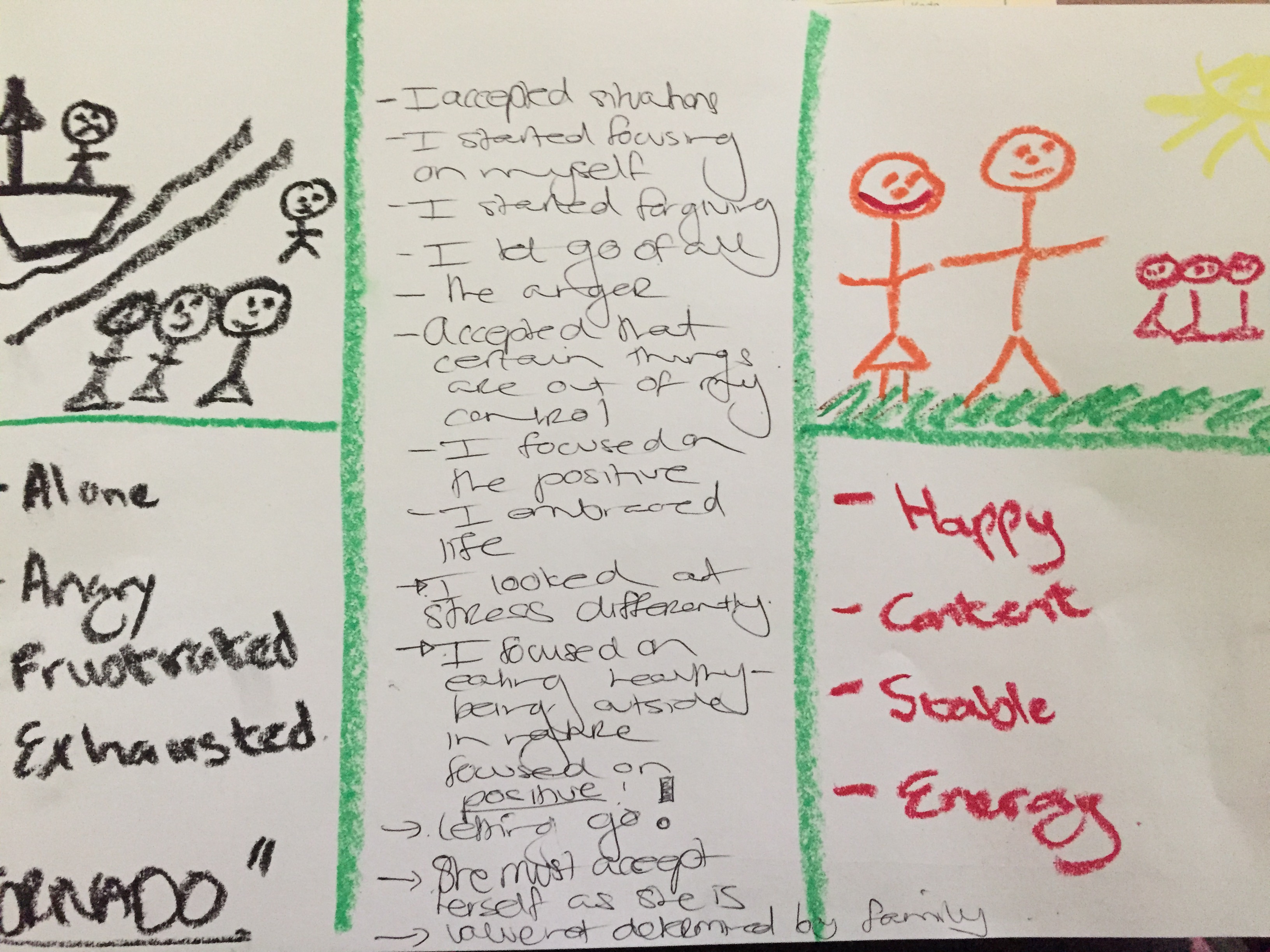
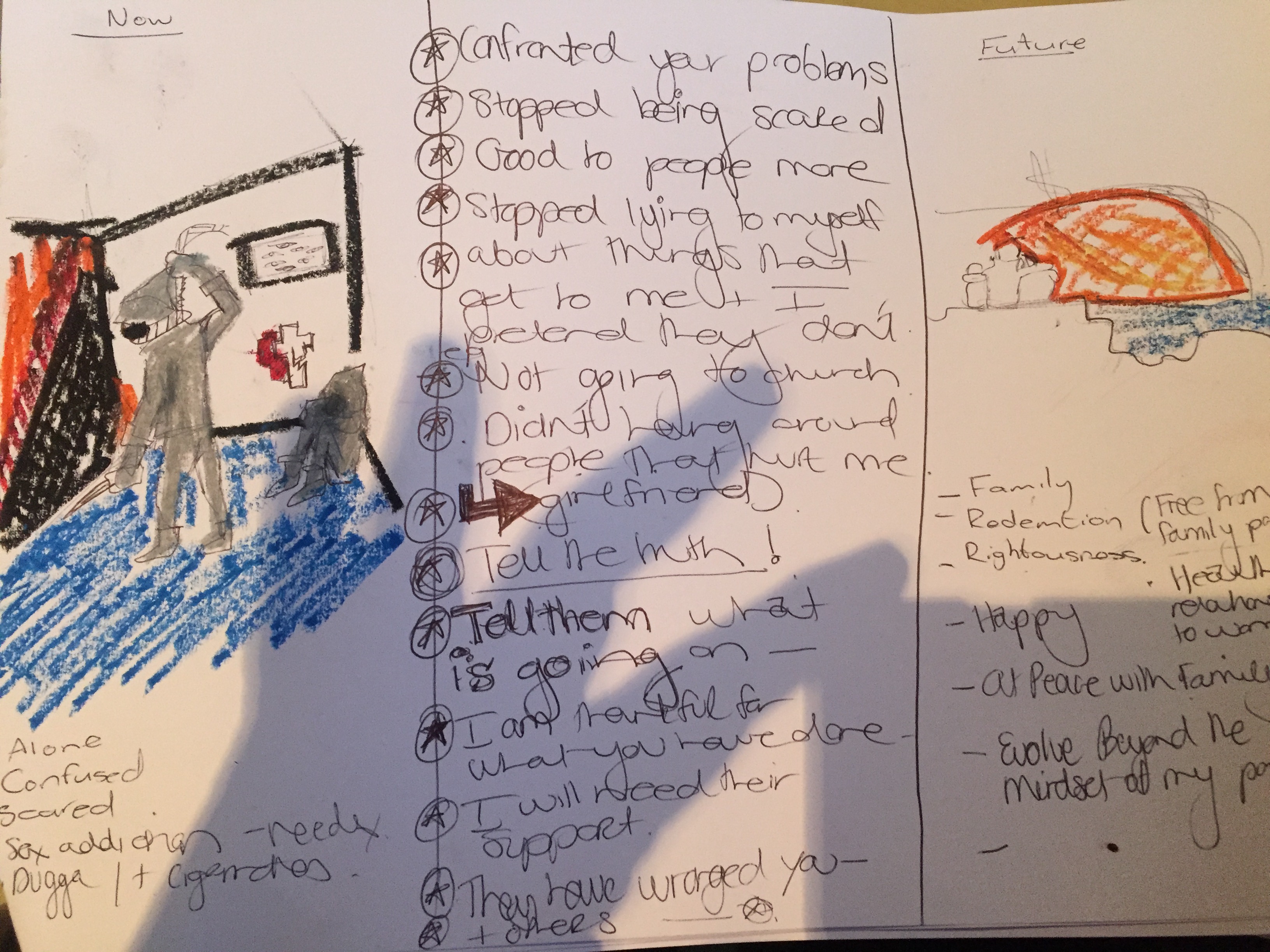
IMAGE THEATRE EXERCISE:
Make a very short piece of movement showing where you are at and then moving to where you want to be, using your body and acting. Make statues of your body of the now, then the transition, then the future. Explore what you need to do to get to the future you desire. Discuss.
Write down the qualities of this future. Educated, Rich, Happy, Married, Loved.
I.E: Happiness, Health, Wealth, Genius, Self Worth, Love and Acceptance
Then make a list of affirmations out of those qualities, as if you already are that.
Ie: I am educated.
I am rich.
I am happy.
I am married.
I am loved.
I love and accept myself unconditionally
AFFIRMATIONS LIST
Rehearse this as if its a script for an actor except this is now your new life. This is your new script.
Discuss your TRANSITION:
How are you going to get to where you want to be in your ideal future?
Does it include children?
Discussion around what fears you need to face to change your future.
If you would like to wait before you have your kids here are some steps for you to take to prevent pregnancy:
-
Don’t give in to peer pressure. Many teenagers can feel left out/behind when their friends start to have boyfriends, or start having sex. Those who have started to do these things early can often talk about it enough to make others feel left out. However, if you do stand your ground and wait until you know you are ready, you will be glad of it. It means you’ll have waited for the right person and the right time.
- Everyone develops at different rates, both physically and mentally, so don’t feel that you should be racing your peers for things like having sex and getting boyfriends.
- Many of your peers will regret their choices in time. Others could even be lying. Don’t just start having sex because other people are if you aren’t ready to do it yourself.
-
Learn to say “No”. This includes saying no to anything you feel uncomfortable with. Whether it’s refusing to have a boyfriend, have any kind of physical contact, have sex or have sex without protection, there is nothing wrong with standing up for yourself. The only 100% safe way to avoid pregnancy is to not have sex, so you shouldn’t feel stupid for not wanting to go through with something.
-
Know what will and won’t result in pregnancy. With sex in general, there are a lot of myths about what will get you pregnant and what will keep you from getting pregnant. A lot of these myths are simple misinformation, and some of them are lies designed to deceive you. Arm yourself with the facts and lower your chances of pregnancy the safe, smart way.
- Unprotected vaginal sex has the highest likelihood of resulting in pregnancy. Male sperm fertilizes the female egg, resulting in the growth of a fetus. Unprotected sex also carries a high risk of disease and infection.
- Pulling out carries some risk of pregnancy. Studies show that typical use of withdrawal has a 18% chance of resulting in pregnancy.[1] This is because some sperm may be released in the male’s pre-seminal fluid, or simply because the male doesn’t pull out quickly enough.
- Unprotected anal sex by itself cannot result in unwanted pregnancy.[2] But because the anus and the vagina are extremely close to each other, there is a chance that sperm could accidentally leak into the vagina, causing pregnancy. Unprotected anal sex carries with it an increased likelihood of STIs, especially HIV/AIDS.
- Oral sex cannot result in pregnancy. As long as the penis does not come in contact with the vagina, there is no possibility that oral sex can lead to unwanted pregnancy.[3] The likelihood of transmitting some STIs, however, is increased with oral sex.
-
Understand the effectiveness of different forms of birth control. All birth controls are not created equal. Some work better than others, and some are preferred by different individuals for different reasons. It helps to know a little about what each form of birth control is, and how effective they are.
- Wearing a condom fails about 17% of the time[1], mostly because of improper usage, and in rare cases, because of manufacturing error. If worn correctly however, condoms work more effectively than pulling out.
- Consider a birth control shot. Depo-Provera only costs twenty dollars a month.
- The pill and the patch, which avoid pregnancy by preventing the female’s ovulation cycle,[4] have about an 8% chance of causing pregnancy with typical use.[1] With proper usage, however, the pill has a 99% success rate in preventing unwanted pregnancy.[5]
- Intrauterine Devices, or IUDs, fail less than 1% of the time.[1] They fall into either hormonal IUD, or copper IUD, and require no upkeep. Some IUDs can stay in place for 10 years.[6]
-
Use protection. Remember that many types of sexual intercourse can cause pregnancy. The best thing to do would be to talk about contraception choices with your partner before having sex, as there are many choices such as the birth control pill, condoms and spermicide.
- If you aren’t comfortable enough with your partner to talk to him or her about protection, you aren’t ready to have sex with them. Make sure that you are fully educated about the effectiveness of all of the different types of birth control before making a decision.
- If you are in doubt about your best options, visit your doctor. They aren’t allowed to tell anyone about what you spoke about, and will give you good advice. Don’t be embarrassed; they will have dealt with things like this many times before.
-
Make sure you know how to put on a condom. If you’re a girl, don’t leave it up to the guy to put it on, as he may object or try talking you out of it. Play it cool: If he says, “I don’t want to put a condom on,” just grin and respond with, “No worries – I’ll put it on for you!” Arm yourself with the knowledge of how to put one on properly and refuse to take no for an answer. And remember, if the guy you’re about to have sex with can’t be bothered to protect his and your health, get out of there and consider yourself lucky for dodging a bullet.
- If you are worried about being caught unprepared then the best thing to do would be to go on the birth-control pill and/or to always have a condom in your bag.
- Bear in mind that condoms are the only way to effectively protect yourself against STIs, or sexually transmitted infections. Do not let yourself be persuaded into having unprotected sex!
- Condoms are often given away for free at places such as schools, colleges and family planning clinics. In many countries, birth control such as the pill or the injection are also available for free.
-
Make sure you know which types of contraception don’t consistently work.When you’re young it can be confusing to hear about all of the different types of birth control, and all of the rumors that come with it. Therefore it can be confusing to work out which ones are actually effective. So here are some of the methods you should avoid. These things do decrease the possibility of pregnancy slightly, but are not effective contraceptive techniques on their own:
- Natural family planning. This is when you use your menstrual cycle, or temperature to help predict when you are ovulating and when you are least fertile. It requires commitment and is only effective if used correctly and tracked over time. It’s especially ineffective during your teenage years since teenage cycles can be erratic and therefore difficult to predict.
- The withdrawal method. This is where the man has to ‘pull out’ before ejaculation. This is extremely unreliable since pre-ejaculation can leak out before he actually climaxes, which can then lead to pregnancy. As well as this is you’d have to trust him to control himself.
-
. Don’t leave anything to chance. If you have had sex and either you didn’t use protection or your protection wasn’t effective (e.g. condom split) then don’t leave it to chance. Get hold of the Plan B contraceptive/morning after pill, which can prevent a possible pregnancy within 3 days of sexual intercourse (although the sooner you have it, the more effective it will be).
- The morning after pill should not be used as a birth-control method, but as an emergency aid. It’s not healthy to consistently use.
- Emergency contraception causes a short but strong burst of hormonal changes that prevent ovulation. It will not cause an abortion.[7]
-
Know what to do if a pregnancy occurs. If you think that there is a chance that you or your partner might be pregnant, you get a pregnancy test as soon as possible. These can be done for free at some pharmacists or by your doctor. It’s important to find out as soon as possible if you are pregnant because it leaves more options for what to do about it.
- It’s important to be aware of options available to you such as getting the baby adopted, or choosing to keep and raise the baby yourself.
OPTIONAL EXERCISES: MAKE A VISION BOARD:
THE PROCESS OF DREAMING, THINKING, IMAGINING AND END RESULT
A Vision Board, also known as a Dream Board, is one of the most powerful ways to put the law of Attraction to work for you.
The Law of Attraction is the secret that we keep forgetting. Our thoughts are the key to what we have in our life. Our thoughts are magnetic. Our thoughts over time become our beliefs. Our beliefs guide our actions and our actions have consequences. These consequences lead to feelings about who we are, they give us our experience. This experience is what we build our life on. Over time, compounded and repeated thoughts, become your experience of reality.
A Vision Board is a collage of words and pictures of the goals and dreams you want to attract in your life.
It is extremely important to use the exact image of what you want to attract, because whatever you put on your Vision Board will become part of your reality!
To make a traditional Vision Board you will need a big piece of cardboard, scissors, glue and tons of magazines and newspapers. Go through the magazines & newspapers and search for images of what you desire in your life and cut them out. Personally, I found looking on the net and printing them out easier for me. Cut out the images and words and glue them on your cardboard.
For more power, add affirmations such as “I love driving my new car” or “I love swimming in my new pool”. This reinforces what you desire. NOTE: Always make an affirmation in the present tense… as if you already have that which you desire. As I say all over this site, it’s all about creating the feeling.
Affirmations are an important part of the process.
Hang your cardboard on the wall where you will see it on a regular basis. I hung mine on the wall directly opposite of my computer, so it is always in front of me while I work in my home office. You may want to put it up at your at your desk or in your bedroom or kitchen. Whatever works for you.
Look at it daily, and really FEEL as if you have already achieved the things on your Vision Board. Be thankful for having those things. Look at your Vision Board as often as possible with focused intent. It will amaze you as the things on your Vision Board start showing up in your life. Remember, you do not decide or plan how they will come, you just visualize already owning the things, and they will simply show up. This is great fun!
A Top 5 List For Making The Law of Attraction Work For You
#1 – KEEP A POSITIVE ATTITUDE – This is certainly one of the simplest methods that you can use to improve the quality of your life using the Law of Attraction. When you have a positive outlook on life, you will constantly be in a positive state of vibration, and you will be attracting positive people and positive events into your life on a daily basis
If things don’t seem to be going very well for you, it’s doubly important that you develop a positive attitude as soon as possible. You can learn to see the best in everything and that slight switch in thinking will begin to change everything in your life. There is a reason why science proves that optimistic people live longer than pessimistic people.
#2 – Use A Visualization Method– It is vital to your success that you actually picture where you want to be in your life. Visualize yourself driving the you desire, being healthier, financially independent, or whatever you heart desires.
How can you hope to have a fulfilling life if you don’t know where it is that you want to go?
The best way to do this is to make a dream board or a vision board, as discussed in the movie The Secret. Don’t worry about how you will get there, only worry about the destination. The absolute best tool I have found for doing this is here: CLICK HERE
#3 – Daily Affirmations – The two most powerful times to use a daily affirmation is when you first wake up before you get out of bed, and the last thought you have just before you go off to sleep. Those are the best times to program your subconscious mind. Certainly, the more times each day the better, but those two times pack the most impact.You have to begin putting down in writing what you want, and then keep saying them to yourself repeatedly. The more often you say them aloud and confirm your dreams, the likelier it is that they will come true.
#4 Have an Attitude of Gratitude – Appreciate, appreciate, appreciate! Learn to be thankful for everything around you. Be thankful for your health, your food, the sunshine, the birds, the grass, the people around you, your family, the two legs that you walk on everyday. You can be thankful for a good tv show, a movie, a song, a good conversation. Be thankful that you have a roof over your head and that you don’t have to sleep in the rain.
You will never have more until you learn to appreciate what you already have.
#5 Like Minded People – Never underestimate the influence that your friends and co-workers have over you. If you surround yourself with negative people it will be much harder to be positive. While you may not be able to change your job, at least not yet, you can certainly seek out people in your community who are practising the Law of Attraction, or other uplifting spiritual activities.
You may be suprised to find that even in the smallest of towns there are groups of people who meet weekly just to uplift each other and trade tips and secrets. Now, with the release of The Secret, there are more groups like these than ever before.
If that’s not an option, join an online community, or frequent websites (like this one) and leave comments on them and develop a personal relationship with the authors and other members.
If I wanted to blatantly self promote, I would have made #5 get a personal trainer and then recommend myself. I do think that everyone needs a personal trainer or life coach, even the personal trainers themselves do.
Whatever route you decide, be proactive. Don’t wait for things to come to you. You have to make things happen for you, and not too you.
written by John Derrick
APPENDIX: Preventing Teenage Pregnancy
How can teenage pregnancy be prevented?
Abstinence
This is when a person decides not to have sex until they are married.
Some think this is old-fashioned, others think it is morally the best thing to do. Don’t worry what other’s think – what do you think?
Delaying Sex
Many people feel that they don’t want to wait until marriage before having sex.
At the same time they don’t want to rush into it and make costly mistakes. So they decide to delay having sex until they are older, more responsible, in a stable relationship with one partner, have a job, or have become independent of their parents.
Does this sound reasonable to you?
If you choose either abstinence or delaying sex, there are some further steps that will help to protect you:
- Choose you friends carefully. Friends should want what is best for you, and they should respect your decision not to have sex. Beware of friends who try and pressure you into having sex.
- Beware of situations, like a group of friends drinking or taking drugs that could lead to unsafe sex.
- Beware of partners who claim ‘You must sleep with me to prove you love me.’
- Listen and learn from those who have gone through teenage pregnancy. They know the mistakes and disadvantages, and can help you to avoid making the same mistakes.
- Listen and learn from your parents about their life experiences. If they put restrictions on you, it is not necessarily because they want to make you suffer. Usually, it is because they want the best for you, so they do it to help and protect you.
If you decide that abstinence and delay sex are not the best decisions for you, and you’d rather not wait before having sex, then you should take time and effort to learn about the best means of protection:
Contraception
Contraception simply means using a method (mechanical or chemical) to prevent pregnancy. There are various contraceptives that work in different ways, but they are all designed to prevent pregnancy. Even if you wish to practice abstinence of delay sex, it’s important to learn as much as you can about contraception – knowledge is power.
Methods
- Oral Contraception…… “the pill”
- Implanon
- Injectable contraception…..”the injection”
- Male and female condoms
- Dual protection
- Emergency contraception (should be used within 5 days of unprotected sex, or condom breakage)- Toll free no: 0800246432
- Male and female sterilisation
For more information visit your nearest clinic
Know your HIV status
What can I do if I’m pregnant?
Take someone you trust with you and visit the Clinic to start antenatal care at 8 weeks (2 months) of pregnancy [rather – “miss one period and go to your nearest clinic and check if you are pregnant or not” and start ANC] Why is this necessary?
Benefits of starting Antenatal care early
- Receive knowledge about pregnancy and HIV
- Voluntary counseling and HIV testing
- Health care worker will assist in developing a plan that is suitable for you and your baby during antenatal, delivery and postnatal and you have to put this plan into practice as soon a you can.
- Prevention mother to Child Transmission (PMTCT) is available for all HIV positive pregnant women.
- Eat healthy nutritious food, exercise, and get plenty of sleep.
- Avoid drugs and alcohol
- Prevent further sexually transmitted infections (STI’S, HIV) during Pregnancy
- Practice safe sex, use a condom
- Infant feeding counselling
