ABOUT ME


About Amanda Gifford – 20 years of experience helping thousands of people.

I provide a gentle, non judgemental, reflective, creative space for those on their journey who need some encouragement, support, upliftment, space to tune in and more.

I am Amanda Gifford.

I have a Masters Degree in Counselling Psychology majoring in Drama Therapy, and I am a HPCSA-registered Drama Therapist (AT 0000027), Family Constellations facilitator and trainer, and change agent with over 20 years of experience working in NGOs, corporate environments, groups, and private practice. I graduated from the California Institute of Integral Studies in San Francisco, USA in 2004 with a Master’s degree in Psychology, specializing in Drama Therapy with a transpersonal focus. I am a South African. I am a pioneer for Drama Therapy in South Africa being one of the first of a handful of people to go overseas and get trained in Drama Therapy which was not available in South Africa. I have also studied 8 years of Family Constellations and have used it as an integral part of my practice.

I run a private practice in Oaklands, Johannesburg, offering both in-person and online sessions.

My niche is working with adults who are going through stress, life changes, dark night of the soul or have daily life issues – family, money, relationships, stress, health issues, spiritual difficulties, depression, trying to make sense of their challenges and so on. I also work with people dealing with recovering from chronic illness. Sleep issues. PTSD. And more.

My approach blends a warm and friendly client centred approach to therapy.

My training draws on a wide range of creative and embodied methods, including play therapy, drama therapy, process theatre, narrative therapy, parts therapy, and family constellations.

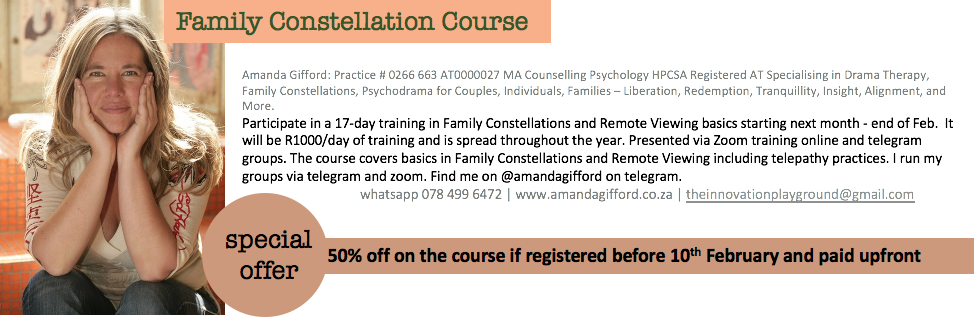
Family Systems Constellations training basics 17 days of training

2022 Q LAB FAMILY CONSTELLATIONS & REMOTE VIEWING BASICS TRAINING WITH AMANDA GIFFORD

Edit”2022 Q Lab Family Constellations & Remote Viewing Basics Training with Amanda Gifford”

Join me on TELEGRAM
https://t.me/+4NndO0fN4mgxN2M0

Q Lab Family & Systems Constellations & Remote Viewing through Constellations Basics Training Curriculum with Amanda Gifford 2022

FAMILY CONSTELLATIONS TRAINING 2022
www.amandagifford.co.za
Cell: 078 499 6472
Subscribe to my channel
https://www.youtube.com/user/GeniusLABTV

What’s New… Amanda will be starting a Quantum Embodiment Family Constellations training which will be 17 days over 12 – 17 months 2022/23.
==========

Spooky action at a distance.

INTRO DAY FOR CONSTELLATIONS: To Be Confirmed. Family Constellations Workshop and an Intro to Family Constellations. First Constellation of the year.

FOUNDATIONAL TRAINING QUANTUM EMBODIMENT

Our first event here will be a Family Constellations Quantum Embodiment Foundation Training with Amanda Gifford on the

DATES TO BE CONFIRMED

1.) 26th & 27th of Feb 2022 Foundation Course Module 1: Intro to the Knowing Field , Quantum Science, Consciousness and Practical

2.) 26th & 27th of March 2022 Foundation Course Module 2:  Basic introduction to Constellations Systems Theory, Image Theatre and the art of embodiment and externalizing the system, Psychodrama, Quantum Physics, Neuroscience and phenomenology, Remote Viewing.

3.) 17th April 2022

4.) All Dates still to be confirmed based on availability of participants.

This Foundation Training does NOT make you a facilitator but you need to complete it to go onto the ADVANCED modules for Facilitator Training.

FACILITATOR TRAINING – BASIC

Choose your advanced track qualification from attending Constellations Workshops throughout the year.

17 days of training over 12-17 months .

You can make up your training from the Family Constellations workshops Amanda runs throughout the year as well as others highly skilled trainers. You must attend some international facilitator trainings as part of your training 4 – 6 days.

17 Days of Family Constellations Workshops direct experience
IF YOU WANT TO QUALIFY AS A CONSTELLATIONS FACILITATOR 
There will be additional requirements that will come in the second year.

4 – 6 days with other international Family Constellations facilitators
(price not included in training)
25 hours of self organised peer group sessions
2 mentoring sessions later in the year
2 days group supervision

Portfolio

You need to have a personal embodiment practice like yoga or dance and meditation practices to work with your intuition and 3rd eye. ( inner site)

4.) International Training Modules: with Gui, Stephan Hausner, Tanja Meyburgh can be done in your training

In take starts in Feb for the Foundation Course.
Please email theinnovationplayground@gmail.com or phone 078 499 6472 to find out more.

17 DAY Foundation Training (maximum 17 participants)

102 hours (17 days over 12- 17 months) contact tuition & experiential learning

The structure of this foundational training will incorporate the basics of Family Constellations Training listed below largely guided by African Constellations training and trainings will be provided by a variety of trainers for electives and will be aligned to International Qualification standards and to Systems Constellations Association of South Africa.

The idea of Constellating the Future or Potential Futures, Creating the Future in the Field, Remembering the Future and the Science and ideas behind this will be explored as a large part of the training in some of the electives. This method will look at the science of Innovation, Time, Quantum Physics, Consciousness Models, the latest in Neuroscience, the Morphic Fields by Rupert Sheldrake and epigenetics by Bruce Lipton and much more….

Over the course  17 days of training modules with Amanda Gifford – over 12 – 17 months you will cover basics in no set order…

1. Basic introduction to Constellations Systems Theory, Image Theatre and the art of embodiment and externalizing the system, Psychodrama, Quantum Physics, Neuroscience and phenomenology, Remote Viewing.

2. Contracts, Boundaries, Preparing the space, Safety, Group Rules and Follow-up
3. International history and background of Constellations and cross-disciplinary theoretical influences
4. Fundamentals of Constellations
• Orders of Love
• Intention Setting
• Healing Sentences
• “The Knowing Field”

5. Ethical considerations and code of conduct
6. Resources: identifying and working with
7. The interview: questions, issue, outcome / miracle question
8. Genograms, relevant info, people and events to include – the idea of unfinished business
9. Working with representatives (including how to set up, the role of representative, coming out of role and aftercare).
10. The Bow – honouring and surrendering in a Constellation.
11. Different Approaches: Classical Constellations, Movements of the Soul & Movements of Spirit-mind
12. Assignments cover student’s own family research, construction of family genogram and research topic based on personal family entanglements.
13. Specific themes presented by student’s based on research topic (ie, adoption, addiction, illness)
14. Contra-indication for constellations
15. The role of the facilitator
• Facilitator Role: as Coach; Shaman; Guide; Mentor etc
• Centering and Presence
• Self-care
• Seeing vs interpretation
• Knowing vs not knowing – the role of knowing
• Checking with the client. Client Centred.

16. Constellations in individual therapy (visualization, figures, papers)
17. Practical Experience constellating one on one
18. Peer group technique
19. Supervised group constellation facilitation

Recommended Reading:
Lyn Buchanan – The Seventh Sense
Roahl Dahl – The Wonderful Tale of Henry Sugar

Love’s Hidden Symmetry – Hellinger
No Waves without the Ocean – Hellinger
In my mind’s eye – Franke
FC Basic Principles and Procedure – Schneider

Recommended Reading:
Art and Practice – Ulsamer
Even if it costs me my life – Hausner
Images of the Soul – van Kamenhout
Peace begins in the soul – Hellinger
Farewell – Hellinger
Invisible Dynamics – Horn and Brick
The River Never Looks Back – Franke

ORGANISATIONAL CONSTELLATIONS – CORPORATE TRAINING

ORGANISATIONAL CONSTELLATIONS

ORGANISATIONAL CONSTELLATIONS

Organisational Constellations reveal hidden dynamics in key areas such as leadership, conflict resolution, relationships between stakeholders or between founders and their successors, culture change, management of innovation & organisational restructuring.

How are Organisational Constellations set up?

After an issue holder describes an organisational dilemma including what needs to be different, the facilitator identifies the key elements of that dilemma. The issue holder then chooses other workshop participants to represent those elements: colleagues, customers, suppliers, owners, workers, governments, The Stock Exchange, other stakeholders, nations or ethnic groups, even more conceptual elements like resources, limitations, goals or the future.

These elements are then intuitively placed in relation to each other. What is surprising is that the representatives are able to feel deeply and report accurately the experience of those they are representing. This reveals hidden dynamics that are worked with creatively to explore new and deep perspectives that go below conventional awareness to reveal profound resolutions.

“A constellation shifts people’s perception of where problems come from and suggests ways to move forward differently that strengthen and build. The new perspectives allow issue-holders fresh insights, a renewed sense of possibility and a strong focus on action. In addition, a synchronous shift sometimes takes place in the real organisation or community that has been represented. “ (Judith Hemming)

Practical Uses for Organisational  Constellations:

  • Defining a strategy for an organization
  • Verifying the consistency of a structure within an organization
  • Preparing negotiations
  • Preparing for restructuring or integration after restructuring
  • Integration after merging or acquiring an organization, company or business
  • Project management
  • Project assessments or creating a new company
  • Company operational diagnosis
  • Management of conflicts within an organization
  • Answer personal questions as “ Should I stay or should I leave? “
  • Clarifying the client’s own place in the organization / company
  • Supporting decision-making in all the business areas
  • As an approaching tool in dysfunctional organisations structure
  • Seeing the systemic “interactive” effects in different company departments
  • Testing the efficiency of important steps or changes in an organisation
  • Trying different possibilities, “a test run”: “Should I do this, or that, or perhaps something else?
  • Supplying additional forms of analysing complex entanglements of business, about family issues in family companies and/or to find ways and solutions of handing business to the next generation
  • As a supervision tool for coaches or consultants: focusing especially in the consultant, so he can better deal with the request of the client.

Systemic Family Constellations

WHAT IS IT?

SOLUTIONS BASED THERAPY: The Systemic Family Constellation approach offers a gentle, profound way of conflict resolution, acknowledging and liberating unseen truths from the family soul or working for solutions in a system. It doesnt have to work only with family issues. A person can work with tapping into the unknown answers in any system by accessing the morphogenetic quantum ‘knowing field’ where direct intuitive access is possible.

In a group or individual setting, a sacred space is created where unspoken truths about our families may be acknowledged. A person briefly describes their life issue, along with family facts. They pick others to represent family members, living or dead, and place them according to their heartfelt, body-knowing image of their family.

A piece of the hidden blueprint is revealed and restructured toward a more balanced, life-giving picture. This movement of honoring the family pictures that were kept in the shadows makes a palpable difference, often in surprising, liberating ways. While each family’s story is unique, there are universal truths that connect us to one another. Systemic Family Constellations offer wisdom about the depth of our loyalty to family functioning like no other approach from western culture.

What often happens is that the experience of being in another’s constellation, and witnessing another family’s unfolding truths, wakes up parts of our own ancestry that want to be seen, acknowledged, and integrated. We are all entangled, in one way or another, with parts of our family history that want to be recognized. We are all very much a part of the larger, human family.

Amanda offers a unique approach to Constellations that includes intergration of Neuroscience, Constellating the Future and other innovative methods.

Coaching Through Constellations and Organisational Constellations available.

For more information on transformation processes contact:

TO BOOK A CONSTELLATION CONSULTATION
Amanda Gifford
Email: theinnovationplayground@gmail.com or amanda[a]geniuslab.co.za
Cell 078 499 6472

Family Therapy Psychodrama Groups

FAMILY COUNSELLING through Individual & Group Sessions using Family Constellations and Psychodrama Groups

What is Psychodrama?

Psychodrama

From Wikipedia, the free encyclopedia

Psychodrama is an action method, often used as a psychotherapy, in which clients use spontaneous dramatizationrole playing, and dramatic self-presentation to investigate and gain insight into their lives.[1]

Developed by Jacob L. Moreno, psychodrama includes elements of theater, often conducted on a stage, or a space that serves as a stage area, where props can be used. A psychodrama therapy group, under the direction of a licensed psychodramatist, reenacts real-life, past situations (or inner mental processes), acting them out in present time. Participants then have the opportunity to evaluate their behavior, reflect on how the past incident is getting played out in the present and more deeply understand particular situations in their lives.[2]

Psychodrama offers a creative way for an individual or group to explore and solve personal problems. It may be used in a variety of clinical and community-based settings in which other group members (audience) are invited to become therapeutic agents (stand-ins) to populate the scene of one client.

Besides benefits to the designated client, “side-benefits” may accrue to other group members, as they make relevant connections and insights to their own lives from the psychodrama of another.

A psychodrama is best conducted and produced by a person trained in the method, called a psychodrama director.[3]

In a session of psychodrama, one client of the group becomes the protagonist, and focuses on a particular, personal, emotionally problematic situation to enact on stage. A variety of scenes may be enacted, depicting, for example, memories of specific happenings in the client’s past, unfinished situations, inner dramas, fantasiesdreams, preparations for future risk-taking situations, or unrehearsed expressions of mental states in the here and now.[2] These scenes either approximate real-life situations or are externalizations of inner mental processes. Other members of the group may become auxiliaries and support the protagonist by playing other significant roles in the scene[2], or they may step in as a “double” who plays the role of the protagonist.

A core tenet of psychodrama is Moreno’s theory of “spontaneity-creativity”.[4] Moreno believed that the best way for an individual to respond creatively to a situation is through spontaneity, that is, through a readiness to improvise and respond in the moment.[5] By encouraging an individual to address a problem in a creative way, reacting spontaneously and based on impulse, they may begin to discover new solutions to problems in their lives and learn new roles they can inhabit within it.[4] Moreno’s focus on spontaneous action within the psychodrama was developed in his Theatre of Spontaneity, which he directed in Vienna in the early 1920s.[6] Disenchanted with the stagnancy he observed in conventional, scripted theatre, he found himself interested in the spontaneity required in improvisational work. He founded an improvisational troupe in the 1920s. This work in the theatre impacted the development of his psychodramatic theory.[5]

Methods

In psychodrama, participants explore internal conflicts by acting out their emotions and interpersonal interactions on stage. A psychodrama session (typically 90 minutes to 2 hours) focuses principally on a single participant, known as the protagonist.[7] Protagonists examine their relationships by interacting with the other actors and the leader, known as the director. This is done using specific techniques, including mirroringdoublingsoliloquy, and role reversal. The session is often broken up into three phases – the warm-up, the action, and the post-discussion.[8]

During a typical psychodrama session, a number of clients gather together. One of these clients is chosen by the group as the protagonist, and the director calls on the other clients to assist the protagonist’s “performance,” either by portraying other characters, or by utilizing mirroring, doubling, or role reversal. The clients act out a number of scenes in order to allow the protagonist to work through certain scenarios.[9] This is obviously beneficial for the protagonist, but also is helpful to the other group members, allowing them to assume the role of another person and apply that experience to their own life. The focus during the session is on the acting out of different scenarios, rather than simply talking through them. All of the different elements of the session (stage, props, lighting, etc.) are used to heighten the reality of the scene.[10]

The three sections of a typical session are the warm-up, the action, and the sharing. During the warm-up, the actors are encouraged to enter into a state of mind where they can be present in and aware of the current moment and are free to be creative. This is done through the use of different ice-breaker games and activities. Next, the action section of the psychodrama session is the time in which the actual scenes themselves take place. Finally, in the post-discussion, the different actors are able to comment on the action, coming from their personal point of view, not as a critique, sharing their empathy and experiences with the protagonist of the scene.[11]

The following are core psychodramatic techniques:

Mirroring: The protagonist is first asked to act out an experience. After this, the client steps out of the scene and watches as another actor steps into their role and portrays them in the scene.

Doubling: The job of the “double” is to make conscious any thoughts or feelings that another person is unable to express whether it is because of shyness, guilt, inhibition, politeness, fear, anger, etc. In many cases the person is unaware of these thoughts or at least is unable to form the words to express how they are feeling. Therefore, the “Double” attempts to make conscious and give form to the unconscious and/or under expressed material. The person being doubled has the full right to disown any of the “Double’s” statements and to correct them as necessary. In this way, doubling itself can never be wrong.

Role playing: The client portrays a person or object that is problematic to him or her.

Soliloquy: The client speaks his or her thoughts aloud in order to build self-knowledge.

Role reversal: The client is asked to portray another person while a second actor portrays the client in the particular scene. This not only prompts the client to think as the other person, but also has some of the benefits of mirroring, as the client sees him- or herself as portrayed by the second actor.[12]

Psychological applications

Psychodrama can be used in both non-clinical and clinical arenas.[5] In the non-clinical field, psychodrama is used in business, education, and professional training. In the clinical field, psychodrama may be used to alleviate the effects of emotional trauma and PTSD.[13] One specific application in clinical situations is for people suffering from dysfunctional attachments.[14] For this reason, it is often utilized in the treatment of children who have suffered emotional trauma and abuse. Using role-play and story telling, children may be able to express themselves emotionally and reveal truths about their experience they are not able to openly discuss with their therapist, and rehearse new ways of behavior.[14] Moreno’s theory of child development offers further insight into psychodrama and children. Moreno suggested that child development is divided into three stages: finding personal identity, recognizing oneself (the mirror stage), and recognizing the other person (the role-reversal stage). Mirroring, role-playing and other psychodramatic techniques are based on these stages.[14] Moreno believed that psychodrama could be used to help individuals continue their emotional development through the use of these techniques.

Related concepts

Sociometry[edit]

Moreno’s term sociometry is often used in relation to psychodrama.[15] By definition, sociometry is the study of social relations between individuals—interpersonal relationships.[15] It is, more broadly, a set of ideas and practices that are focused on promoting spontaneity in human relations. Classically, sociometry involves techniques for identifying, organizing, and giving feedback on specific interpersonal preferences an individual has. For example, in a psychodrama session, allowing the group to decide whom the protagonist shall be employs sociometry.[5]

Moreno is also credited for founding sociodrama.[16] Though sociodrama, like psychodrama, utilizes the theatrical form as means of therapy, the terms are not synonymous. While psychodrama focuses on one patient within the group unit, sociodrama addresses the group as a whole. The goal is to explore social events, collective ideologies, and community patterns within a group in order to bring about positive change or transformation within the group dynamic.[16] Moreno also believed that sociodrama could be used as a form of micro-sociology—that by examining the dynamic of a small group of individuals, patterns could be discovered that manifest themselves within the society as a whole, such as in Alcoholics Anonymous. Sociodrama can be divided into three main categories: crisis sociodrama, which deals with group responses after a catastrophic event, political sociodrama, which attempts to address stratification and inequality issues within a society, and diversity sociodrama, which considers conflicts based on prejudice, racism or stigmatization.[16]

Drama therapy[edit]

The other creative arts therapies modality drama therapy, which was established and developed in the second half of the past century, shows multiple similarities in its approach to psychodrama, as to using theatre methods to achieve therapeutic goals.[17] Both concepts however, describe different modalities. Drama therapy lets the patient explore fictional stories, such as fairytales, myths or improvised scenes, whereas psychodrama is focused on the patient’s real-life experience to practice “new and more effective roles and behaviors” (ASGPP).[18]

History[edit]

Jacob L. Moreno (1889–1974) is the founder of psychodrama and sociometry, and one of the forerunners of the group psychotherapy movement.[19] Around 1910, he developed the Theater of Spontaneity, which is based on the acting out of improvisational impulses. The focus of this exercise was not originally on the therapeutic effects of psychodrama; these were seen by Moreno to simply be positive side-effects.

A poem by Moreno reveals ideas central to the practice of psychodrama, and describes the purpose of mirroring:

” A meeting of two: eye to eye, face to face.
And when you are near I will tear your eyes out
and place them instead of mine,
and you will tear my eyes out
and will place them instead of yours,
then I will look at me with mine.”[3]

In 1912, Moreno attended one of Sigmund Freud‘s lectures. In his autobiography, he recalled the experience: “As the students filed out, he singled me out from the crowd and asked me what I was doing. I responded, ‘Well, Dr. Freud, I start where you leave off. You meet people in the artificial setting of your office. I meet them on the street and in their homes, in their natural surroundings. You analyze their dreams. I give them the courage to dream again. You analyze and tear them apart. I let them act out their conflicting roles and help them to put the parts back together again.'”[20]

While a student at the University of Vienna in 1913-14, Moreno gathered a group of prostitutes as a way of discussing the social stigma and other problems they faced, starting what might be called the first “support group“. From experiences like that, and as inspired by psychoanalysts such as Wilhelm Reich and Freud, Moreno began to develop psychodrama. After moving to the United States in 1925, Moreno introduced his work with psychodrama to American psychologists. He began this work with children, and then eventually moved on to large group psychodrama sessions that he held at Impromptu Group Theatre at Carnegie Hall. These sessions established Moreno’s name, not only in psychological circles, but also among non-psychologists. Moreno continued to teach his method of psychodrama, leading sessions until his death in 1974.[21]

Another important practitioner in the field of psychodrama is Carl Hollander. Hollander was the 37th director certified by Moreno in psychodrama. He is known primarily for his creation of the Hollander Psychodrama Curve, which may be utilized as a way to understand how a psychodrama session is structured. Hollander uses the image of a curve to explain the three parts of a psychodrama session: the warm-up, the activity, and the integration. The warm-up exists to put patients into a place of spontaneity and creativity in order to be open in the act of psychodrama. The “activity” is the actual enactment of the psychodrama process. Finally, the “curve” moves to integration. It serves as closure and discussion of the session, and considers how the session can be brought into real life – a sort of debriefing.[22]

Although psychodrama is not widely practiced, the work done by practitioners of psychodrama has opened the doors to research possibilities for other psychological concepts such as group therapy and expansion of the work of Sigmund Freud. The growing field of drama therapy utilizes psychodrama as one of its main elements. The methods of psychodrama are also used by group therapy organizations and also find a place in other types of therapy, such as post-divorce counseling for children.[23

Are you seeking resolution for conflicts within your family? Do you have conflicts with your adult children, siblings or parents? We can help your family resolve conflicts, heal hurt feelings and restore harmony.

What you can expect from family counselling with us:

Much of the work of counselling families requires preparation and an agreement among family members to follow some simple ground rules.

Before we meet with you, as a family, we will talk with each of you individually. This can be a brief interaction, and not longer than 30 minutes per person.

We want each member of the family to be clear about the purpose of the meeting, the goals they would like to achieve and their desired outcome.

When we meet with you and your family, everyone will know what is on the agenda. It may be that a new issue will arise, or someone will realize how something we are discussing is the result of another event or interaction. That is fine. But this is where our expertise comes in.

We will determine as a group whether or not the new topic should be discussed right now. In our experience, some family members are very skilled at changing the subject when the issue is uncomfortable for them, or they want to avoid it. If we have not resolved the topic we are currently engaged in, we will save the new subject for another meeting.

Another very important reason for having an agenda is because most people need some time to process new information in order to formulate an appropriate response. No one should have to fear that they will be “blindsided” by an issue or accusation that they have been unaware prior to our session.

Most situations can be understood if we take the time to understand them from another perspective or from a different interpretation. This calls for respect. In family therapy, we are seeking to increase understanding among the members, not to prove one person right and the other person wrong.

We have control over ourselves, our attitudes, and how much effort we put into something.

We do not have control over other people, what they do, think, or believe. This includes people in our own family. And frustratingly, for the older generation, we have to recognize that the culture has changed, and expectations and beliefs have changed. We may not like it, and we certainly have the right to say so, and why.

But, we will be happier in the long run if we can learn to accept we do not have control over the changes we see. We do not have to approve of behavior or actions we find unacceptable, in order to spend pleasant time with our families. There may be some areas in your family that you do not need to talk about.

We can only attempt to seek understanding of others, and let go of our expectations of what others should do, or not do.

We can ask our family members to do certain things to help us feel more comfortable, or to help us get along with each other better, but we cannot demand change from them, if they do not want to change, or are unable to change.

What you can expect from family counselling with us is to clarify what various members of the family actually want and what they would like to see happen in the family that is not happening now. You can expect help with reframing situations that have happened in the past. You can expect help with increasing your ability to understand each other from the other’s point of view. This does not require that you change your point of view. Sometime we just have to agree to disagree. This can really be okay.

What you can expect from family counselling with me is help focusing on “problem solving” and learning to separate the “problem” from the individual involved. You are not the “problem” and your family members are not the “problem.”

If we want peace, we must learn acceptance. 

What you cannot expect from family counselling with us

We will not permit personal attacks, insults or accusations during family therapy sessions. In family therapy, the members need to talk from their own perspective. Sharing feelings of frustration, anger, and hurt are an expected part of the process, but those feelings need to be expressed with respect and without blame. 

Anger is a healthy, normal response to a perceived injustice, but people are not volcanoes or steam kettles, and emotions are transient. We now understand that anger is best managed by gaining a different perspective on the situation that made us angry.

Sometimes people want to express feelings of resentment, hurt and anger towards members of their family. Some people believe that they will feel better if they can tell a family member what they think of them. They may refer to this as “needing to get something off my chest.” Or they may think that their family member “needs” to hear their opinion of their character or actions. They may even believe this will cause their family member to change, and improve, and should even feel grateful for hearing the “constructive criticism.”

People do need to express their feelings, but the appropriate place to do that is in individual therapy. We have never seen a relationship between two people improved by criticism, scolding or personal attacks. No one has an exclusive claim on the “truth.” Telling another person the “truth” for their own good never achieves anything except to create new resentments, hurt and anger.

When people feel judged, they will stop listening. Expressing your judgments about other family members does not lead to resolution or peace. It damages relationships even more.

If a family member comes to family therapy with the goal of proving another family member wrong or to try to justify their own position, they will not get satisfaction. Family counseling will not be successful if it involves blaming, shaming or punishing any members.

We will not facilitate a session where one member hurts the other by verbal abuse, personal attacks or blaming behavior.

A word for adult children
Becoming an adult changes your relationship with your parents, but it does not mean you no longer need to respect and honor them.

Your parents and parents-in-law are not your peers. They are your parents, and it is not your job to correct them or pass judgment on them. That was a job their parents did. Remember when you think about the Ten Commandments that there is a commandment to “Honor your father and your mother.” There is no commandment to honor children.

For parents with adult children

Married adult children need to respect and honor their parents, but their first priority is to their spouse and own children.

Parents of adult children need to respect their autonomy and independence. When adult children marry, their parents need to respect the new couple and family. Conversely, adult children need to recognize that their parents are not going to take orders from their children.

Family Constellation Therapy & It’s Role In Healing Autism

Family Constellation Therapy & It’s Role In Healing Autism

Published on July 16, 2018

IN BRIEF

  • The Facts:Trans-generational traumas add to our toxic burden and predispose us to illness. Misfortune or unresolved conflict in our ancestry can create disturbances which filter down into the psyche, nervous system and metabolic functioning.
  • Reflect On:What conflict exists in your ancestry? Could it be impacting your family’s health?

Family Constellation Therapy, sometimes known as Systemic Constellations, was created by Bert Hellinger, a German psychotherapist. This amazing method is used to uncover the source of chronic conditions, illnesses and emotional difficulties that may have roots in the inter-generational family systems, rather than the individual, and may be connected to a key stress event.

Could resolving past family trauma help unlock the symptoms known as autism? Sadly, some form of autism is now observed in 1 in 55 children and is growing at a rate of more than 1,100 percent. Western medicine focuses on medication to suppress symptoms and alternative approaches focus on treating the underlying biomedical, physical, psychological and environmental causes of autism.

However, illness not only originates in our physical body, but can also originate in our energetic and spiritual body as well. So, it becomes imperative that we treat the entire person for a fuller recovery.

“Autism spectrum disorders can only be fully healed by restoring the self-regulation of the system and making it fully functional.” – Dr. Dietrich Klinghardt

This moving and powerful work in the family’s energetic field is also referred to as “the knowing field.” And, is used to examine the emotional factors connected to conditions such as illness, allergies, alcoholism, ADHD and autism. Some parents of children on the autism spectrum have experienced profound transformations as a result of this work for themselves, as well as for their families.

These children are often the recipients of unhealed trans-generational family issues because of their extraordinary energetic sensitivities.  This perpetuates their illness.

Family constellation therapy work, focuses deeper on the ancestral family blueprint – the family soul. Our souls carry information from one lifetime to the next and from one generation to the next.

Children often hold the energetic field of their ancestors. This appears especially true with children with autism, because they are super-sensitive and spiritual souls. Who, often become unconsciously entangled with others in their family in the name of belonging or wanting to help restore balance in their family system. The purpose of a Family Constellation therapy session is to reveal that hidden dynamic and point the way toward resolution. And, there are often magical improvements in these children when we resolve issues in the family history.

The Forgotten One

One of the participants in a group “Michelle,” has a brother with severe autism who couldn’t speak and was very self-destructive. She was afraid that he could never live a more “normal” life because he refused all biomedical treatment and other therapies offered to him. In the initial set-up, the facilitator had Michelle, her brother, and both parents of her family represented  in “the field.”

The participant representing her brother was hiding under a nearby chair and was rocking back and forth. Both parents were standing in the field, seemingly disinterested in what was going on. The sister (Michelle) kept looking down at the floor. Later in the set-up, it was revealed that the sister was looking down at a baby—a baby who had died of birth defects three generations ago. This baby hadn’t been properly acknowledged or mourned.

In essence, the brother with autism had taken the place of the “forgotten” baby. Representatives for the great-grandparents (the forgotten baby’s parents) were brought into “the field.” Then, the baby was embraced by the parents and a short dialogue was exchanged. The baby reported that he felt more at ease, relaxed and became more comfortable. A healing took place that was so profound.  A year later, “Michelle” reported that her brother was starting to take a more active role in his recovery and was beginning to accept treatment.

War and Mental Illness

“Andrew,” a man in his twenties who was diagnosed with Asperger’s, participated in my group. He claimed that mental illness and psychosis ran in his family. He cried as he explained that he was taking multiple medications for bi-polar disorder. He claimed it was difficult for him to hold down a job.  He often felt very alone. He stated that he did not have a good relationship with his parents. He said that his mom was “crazy.” The parents divorced when he was very small and he blames himself and his issues for why they split.

In the initial set-up of “his field,” Andrew was represented along with mental illness and his parents.   As it unfolded, it became more obvious that something profound had happened in the past. Mental illness began taking on characteristics of a war and hidden dynamics were revealing themselves.

Later in the set-up, Andrew’s representative started choking, like he was trying to catch his breath. He was mumbling, “I deserve death because I have killed others.”

It was uncovered that his great-great grandfather was in World War I and was killed during a mustard gas attack. Andrew was doing service to the family out of deep love. He took on the feelings of the victim and the perpetrator, which caused him deep inner conflict. Hence, he was carrying the burden of mental illness and autism. In doing this soul work, Andrew was able to find resolution for himself as well as all the members of his family.

In conclusion, trans-generational traumas add to our toxic burden and predispose us to illness. Misfortune or unresolved conflict in our ancestry can create disturbances in the family field, which filter down into the psyche, nervous system and metabolic functioning. Children with health issues are particularly sensitive to such disturbances.

Therapy and biomedical interventions may even succeed better after a healing Family Constellation session with an experienced facilitator. Fortunately, it is never too late to heal wounds from the past. Constellation work is unique in that any living family member can do this intervention for the benefit of all.

South African National Arts Therapists Association ( SANATA) Videos by HPCSA Registered Arts Therapist Practitioners project

Two Arts Therapists in South Africa, Noa Belling and Amanda Gifford introduce themselves and their work as part of a national project for SANATA ( South African National Arts Therapists Association) to get to know each other as resources as well as share ourselves and our work as resources to each other. Amanda Gifford and Noa Belling are registered Arts therapists practicing in South Africa. Amanda Gifford www.amandagifford.co.za | 078 499 6472 Brief Bio: Amanda Gifford is a Health Professional Council of SA HPCSA Registered Arts Therapist – Registered Drama Therapist ( Johannesburg, South Africa) with a private practice in Fourways Bryanston Area. She has an MA Counselling Psychology in Drama Therapy from the California Institute of Integral Studies, San Francisco USA 2004 and an Honours University of Cape Town, South Africa 1994 as well as a BA UCT 1993 South Africa. She uses Family Constellations as an integral part of her practice. She also trained with Family Constellations Africa 2005/2006 and Family Constellations Africa 2007/2008 with various local and international facilitators. She is busy with her Shamanic Constellations training with Guilherme Barcellos C. Souza ( Gui) from Brazil. She has also been a student at Ramtha’s School of Enlightenment for 20 years. Her work is an integration of her 20 years of her spiritual journey and education. She offers a mix of Drama Therapy, Psychodrama and Family Constellations work with a transpersonal orientation in South Africa.

Noa Belling website: www.noabelling.com ABOUT NOA MA SOMATIC PSYCHOLOGY, USA International bestselling author and psychologist Noa Belling uses her many years’ experience of intellectual and physical discipline to guide others in enhancing vitality and life fulfillment. Noa holds a Masters degree in somatic (body-mind) psychology through Naropa University. Her background includes over a decade of teaching applied somatic psychology skills as part of psychology training and continuing education programs, running a private psychotherapy practice and presenting talks and workshops in the corporate sector. Noa’s first career as a professional ballet dancer and then a Yoga teacher also influence her approach to wellbeing. WHAT IS SANATA? The South African National Arts Therapies Association is the professional Association, recognised by the Health Professions Council of South Africa that promotes the common interests of arts therapists and the four arts therapy professions – art, music, drama and dance movement therapy – across South Africa. One of its key objectives is to stimulate, coordinate and oversee a collaborative research agenda that results in an increase in relevant engaged research for quality publications reflecting the experiences of arts therapies practitioners, clients and communities in South Africa.

SECOND VIDEO: 18th July 2019

LESLEY PALMER is a Drama and Movement Therapist (MA, UK), Family Constellations Therapist (SA) and Play Therapist (PGDip, UK). She is registered with the Health Professions Council of South Africa. Lesley’s therapeutic work is with children, adolescents and adults, with a focus on childhood bereavement, children facing challenging transitions, and with adults in the development of capacity for Presence, Resilience and Transformation, where her work integrates Creative Arts Therapy techniques, Constellations, active meditation and Inquiry methods. Her private practice is based both in Kenilworth and Cape Town city bowl, where she works with individuals and focus groups. Beyond her private work, Lesley’s commitment is to social and individual healing for South Africans affected by trauma, loss and violence who have limited access to therapy, and to this end has been a therapist, performer, facilitator, supervisor, trainer and project developer in a range of contexts in the NPO field. She has trained adults in the caring professions in the arena of Child Development, Play and Self Care in South Africa, Zimbabwe, Lebanon and Brazil. She is currently the Director of GroundSpring Playback Theatre Company in Cape Town and Clinical Supervisor for Intern Drama Therapists at Drama for Life, University of the Witwatersrand (SA). www.presenceinaction.co.za www.facebook.com/groundspringtheatreco Contact Lesley for a session cell: 082 828 5917

MICHELLE BOOTH is an Art Therapist, Coach and Biodanza Facilitator. In 2006 she completed her Masters in Art Therapy in Edinburgh, Scotland and returned to South Africa in December 2006. From 2007 -2016 she lived in Johannesburg working both in private practice and for the Sophiatown Community Psychological Services. She moved to Knysna in 2016 and works in private practice. She is the founding Chairperson of SANATA. Facebook Page: Art Therapy with Michelle Booth @arttherapymichelle She can be contacted at michelle@michellebooth.co.za

Alice in Quantum Land, Family Constellations & The Morphogenetic Field

Proposal Presentation of Paper at the World Music Congress at University of Pretoria: 7 – 11 July 2020 by Amanda Gifford ( to be confirmed)
20 minute presentation on Family Constellations.

We can access knowing about much more than we realise. We live in a field of Consciousness and Energy and depending on how we perceive reality so we create the outcomes of the nature of our reality. Family Constellations was founded by Bert Hellinger who trained with the Zulus in KZN as a Sangoma for 15 years and then took the practice back to Europe and created a hybrid form of African Traditional Wisdom that was mixed with European psychologies specifically Phenomenology. Family Constellations, also known as Systemic Constellations and Systemic Family Constellations, is an alternative therapeutic method which draws on elements of family systems therapy, existential phenomenology and Zulu attitudes to family. In a single session, a Family Constellation attempts to reveal a supposedly unrecognised dynamic that spans multiple generations in a given family and to resolve the effects of that dynamic by encouraging the subject, through representatives, to encounter and accept the factual reality of the past. It can be applied in various ways. In this 20 minute presentation I will give a short presentation on how I work with it, a bit of the science and present a few client cases.

Testimonial: Deep Cleanse Healing through Family Constellation Therapy with Amanda Gifford

Testimonial: Deep Cleanse Healing through Family Constellation Therapy with Amanda Gifford

March 12, 2019 by participant Chelsey May

On the 16th of February 2018, my Step Father Leon Orsmond went missing in Kigali, Rwanda. Through sources, it was discovered that he was arrested for being politically expressive about his opposing political views. Police had no records of his arrest and government institutions were of no proactive assistance, even to this day.

Hovering in darkness, grief and confusion I was extremely grateful to Amanda for offering a constellation space for me to digest this unnerving experience. Through a specific embodied structure, the family constellation space offers an opportunity to become conscious of and break patterns connected to ancestors and current family members. Inspired by Zulu wisdom and structural beliefs around family, Bert Hellinger developed this multi-dimensional group process to guide one towards healing unconscious family wounds that still play out through us on a daily basis. Members of the group are ‘enrolled’ as representatives of one’s family, while the therapist guides you towards recognizing and confronting these wounds.

The beauty of this therapy is that you never know what you’re going into, yet you come out with peace either way – so there really isn’t much to fear if you approach the process with courage. During my constellation, Amanda effectively guided me towards connecting with the energy of what was going down and what could be done to move forward in the situation with Leon. My initial ‘goal’ was to find out what happened to him and what to do to find him but that’s not totally how it works, although there was strong reason to believe that he either did not want to be found or he was already dead. As Amanda weaved us deeper into the journey, I was rolled into a profound understanding and awareness of how I was holding onto deep pain from Leon living in another country for the past 8 years. I also gained a new awareness of how this pain had been negatively playing out in my life – specifically through my career and romantic relationships. All of this was plenty of new ‘stuff’ to digest so the session ended at this point. Had I chosen to go deeper into the process I would have likely gone into broader ancestral patterns calling for healing. I definitely recommend several sessions to deepen the cleansing.

I have been part of several constellation sessions with Amanda where I was a representative for others diving into the entanglements of family wounds. Overall, with her own grounded cosmic wisdom, Amanda brings an expanded mindfulness of the broad possibilities of where a wound is sitting in the family line and what needs to happen to confront and heal this wound, for the sake of the individual and their descendants. Amanda’s use of elements (such as water) and various medicines placed in the space as representatives adds extra support and power to the process. If you’re brave enough to do this work, I highly recommend Amanda to hold you through it. With her magical and grounded feminine presence, you’ll be sure to experience subtle, yet mind-blowing breakthroughs.


If you are keen to get in touch with Amanda for a constellation, here are her details: Whatsapp – 0784996472, Email – amanda@geniuslab.co.za. Visit her website – www.amandagifford.co.za

FAMILY CONSTELLATIONS TRAINING 2019

FAMILY CONSTELLATIONS TRAINING 2019
www.amandagifford.co.za
Cell: 078 499 6472
Subscribe to my channel
https://www.youtube.com/user/GeniusLABTV

What’s New… Amanda will be starting a Quantum Embodiment Family Constellations training which will be 18 days over 2 years in March 2019.
==========

Spooky action at a distance.

INTRO DAY FOR CONSTELLATIONS: Saturday 26th of January 2019 8:30 – 5pm Family Constellations Workshop and an Intro to Family Constellations. First Constellation of the year.

FOUNDATIONAL TRAINING QUANTUM EMBODIMENT

Our first event here will be a Family Constellations Quantum Embodiment Foundation Training with Amanda Gifford on the

1.) 8 – 10th March 2019 Foundation Course Module 1
2.) 15th – 17th of March 2019 Foundation Course Module 2

6 days will give you your foundational training.

R12 000 which will include 4 one on one Family Constellations individual therapy sessions with Amanda which will happen over this time. Intake therapy session before 8th of March.
Then 2 follow up therapy sessions in the week of 11th – 15th March and one integration session in the week after 15th March.

Medical Aid Claims possible( depending on which medical aid)

This Foundation Training does NOT make you a facilitator but you need to complete it to go onto the ADVANCED modules for Facilitator Training.

FACILITATOR TRAINING – ADVANCED

Choose your advanced track qualification from attending Constellations Workshops throughout the year.

Then you would move into the facilitator training
10 days of training over 2 years.
You can make up your training from the Family Constellations workshops Amanda runs throughout the year as well as others highly skilled trainers. You must attend some international facilitator trainings as part of your training 4 – 6 days.
Interview
10 Days of Family Constellations Workshops
4 – 6 days with other international Family Constellations facilitators
(price not included in training)
25 hours of self organised peer group sessions
2 mentoring sessions
2 days group supervision
Portfolio

You need to have a personal embodiment practice like yoga or dance and meditation practices to work with your intuition and 3rd eye. ( inner site)

R30 000 over 2 years

4.) International Training Modules: with Gui, Stephan Hausner, Tanja Meyburgh can be done in your training

Intake starts in January for the Foundation Course.
Please email amanda@geniuslab.co.za or phone 078 499 6472 to find out more.

Transpersonal Healing Sessions with Amanda

Individual Therapy

Couples Therapy
Group Therapy
Family Therapy

Creative Therapy Approach – Drama Therapy, Psychodrama & Family Constellations

Phone to book or for more info: Whatsapp Amanda 078 499 6472 now.

Come for an individual session for 90 minutes to start your transformation process.

Issues considered in transpersonal psychology include spiritual self-development, self beyond the ego, peak experiencesmystical experiencessystemic trance, spiritual crises, spiritual evolution, religious conversionaltered states of consciousness, spiritual practices, and other sublime and/or unusually expanded experiences of living. The discipline attempts to describe and integrate spiritual experience within modern psychological theory and to formulate new theory to encompass such experience.

Range of Fees

Medical Aid Rates

TO BOOK WHATSAPP for session booking 078 499 6472 with your name, surname,

Upfront payments required to book your session.
48 hour cancellation needed.

HPCSA registered Medical Aid claims possible for some medical aid schemes like Discovery.

Payments via Paypal for overseas clients.